
It is a spectacle of impossible speed and bewildering physics. Two athletes, separated by a nine-foot table, engage in a blur of motion as a tiny ball, weighing less than three grams, rockets back and forth. This is the modern game of table tennis—a display of supreme athleticism and strategy. Yet, the history of table tennis reveals that this global, high-tech sport began not with a bang, but with a gentle, onomatopoeic whisper. Its earliest names were “Whiff-Whaff,” “Flim-Flam,” and the most enduring of all, “Ping-Pong.”
The story of the history of table tennis is a remarkable journey from an improvised, upper-class social diversion to a politically significant global phenomenon. It is a tale of technological leaps, commercial battles, and even international diplomacy. For all its evolution into a professional spectacle, the sport has never lost its identity as one of the world’s most accessible and unifying games. From the Victorian parlor to the modern game room, it remains a perfect centerpiece for connection and fun.
Key Takeaways
- Table tennis originated in the 1880s as an improvised after-dinner amusement among the English upper class, who used books for nets and cigar box lids for paddles.
- The introduction of the celluloid ball around 1901 created the sport’s iconic sound and led to the commercial “Ping-Pong” craze, which also created the naming split between the branded game “Ping-Pong” and the official sport “Table Tennis.”
- Technological innovations, specifically the pimpled rubber paddle in 1902 and the sponge bat in 1952, dramatically increased the role of spin and speed, transforming the game into a contest of complex strategy and athleticism.
- The sport famously became a tool for international relations in 1971 with “Ping-Pong Diplomacy,” a series of friendly matches that helped thaw Cold War tensions between the United States and China.
- After making its debut in the 1988 Seoul Games, table tennis has become a premier Olympic sport, yet it remains a universally popular recreational activity perfect for any home game room.
How Did Table Tennis Begin as a Victorian Parlor Game?
To understand the birth of table tennis, one must first step into the parlors of late 19th-century England. For the burgeoning middle and upper classes, the Victorian era brought unprecedented leisure time governed by rigid social etiquette. This created a fervent demand for respectable indoor group entertainment, especially activities that could bring young men and women together in a supervised setting. Parlor games became the lifeblood of social gatherings, and it was this specific need—for a non-strenuous, engaging indoor activity—that set the stage for a new invention.
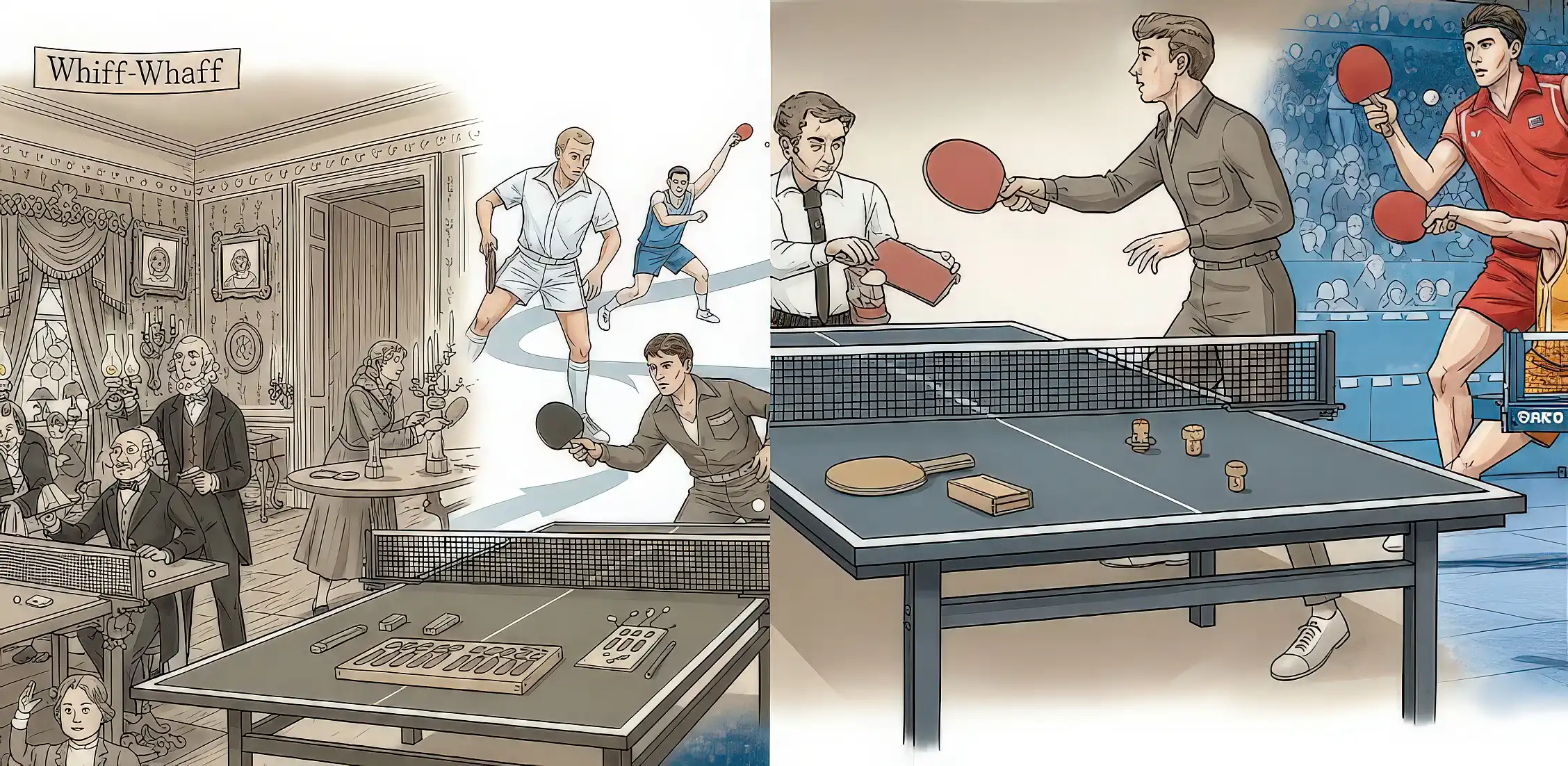
The game itself emerged in the 1880s as a creative adaptation. Enthusiasts of the popular outdoor sport of lawn tennis, driven indoors by England’s often-inclement weather, sought to recreate their game in miniature. The equipment was born of pure improvisation. The grand dining table served as the court, and a row of books stood on their spines became the net. For paddles, players used whatever was at hand—often the lids of cigar boxes or even other books. The ball was perhaps the most inventive element: a rounded champagne cork or a simple ball of string was batted back and forth. The onomatopoeic nature of the early game gave rise to its first charmingly descriptive names, like “Whiff-Whaff,” reflecting the organic, unstructured, and purely social origins of a game born from the sounds of play.
What Sparked the “Ping-Pong” Craze and Naming Split?
The transition from a scattered parlor activity to a commercial sensation was swift. English manufacturer John Jaques & Son Ltd., already famous for popularizing games like Croquet, saw the immense potential in this new amusement. In 1891, the company registered a version called “Gossima,” but the game’s first great leap came with a change in sound. Around 1900, the introduction of a new, hollow celluloid ball transformed the game’s acoustics, producing a far more distinctive “ping” and “pong.”
Recognizing the name’s catchy appeal, Jaques trademarked “Ping-Pong” in 1901 and relaunched the game to massive public excitement. The craze crossed the Atlantic when Jaques sold the American rights to Parker Brothers, who enforced the trademark just as aggressively. This tight commercial control had a crucial, if unintended, consequence. Rival manufacturers, legally blocked from using the wildly popular “Ping-Pong” moniker, were forced to market their equipment under a more generic name: “table tennis.” This created a schism that has persisted for over a century. Early sports bodies were compelled to rename themselves “The Table Tennis Association” to avoid legal threats. This formalization continued, and in 1926, the International Table Tennis Federation (ITTF) was founded in Berlin. This is the historical root of the modern perception: “Ping-Pong” often evokes a casual, social game, while “Table Tennis” suggests serious, athletic competition.
What Inventions Revolutionized How the Game Was Played?
The evolution from a pastime to a game of skill was driven by two key technological breakthroughs. The first was the celluloid ball epiphany of 1901. English enthusiast James Gibb discovered lightweight celluloid toy balls on a trip to the United States and realized their potential. Unlike unpredictable rubber or cork balls, the hollow celluloid ball offered a consistent, lively bounce, making extended rallies and skill-based play possible for the first time.
The second breakthrough was the rubber revelation of 1901-1902. English player E.C. Goode had the idea to fix a sheet of pimpled rubber to his wooden paddle. This new surface could “grip” the ball, allowing players to impart spin and adding a new dimension of strategy. This “hardbat” paddle defined play for 50 years, until the next great disruption. At the 1952 World Championships, Japanese player Hiroji Satoh appeared with a revolutionary sponge bat—a wooden blade covered with a thick layer of foam sponge. The sponge acted like a spring, catapulting the ball with unprecedented speed and spin. Satoh’s victory signaled a massive power shift to Asia and made a new, devastating stroke possible: the loop. This stroke uses a sharp, upward brushing motion to impart extreme topspin, becoming the foundational offensive weapon of the modern game.
How Did a Simple Game Influence Global Politics?
In the early 1970s, the United States and the People’s Republic of China were locked in a Cold War standoff with no diplomatic relations. The event that began to thaw this relationship was a chance encounter at the 1971 World Table Tennis Championships in Nagoya, Japan. American player Glenn Cowan accidentally hopped onto the Chinese team’s bus. After a moment of tense silence, China’s star player, Zhuang Zedong, shook Cowan’s hand and presented him with a gift.
This small gesture of sportsmanship had enormous repercussions. Chinese Chairman Mao Zedong personally approved an official invitation for the U.S. team to visit China. On April 10, 1971, nine American players became the first official American delegation to enter the country since 1949. The tour that followed was an exercise in goodwill, with matches billed as “friendship matches.” The guiding principle, repeated by their hosts, was “Friendship First, Competition Second.” Dubbed “Ping-Pong Diplomacy” by the press, the visit captivated the world. It created a friendly atmosphere that broke the diplomatic stalemate, paving the way for President Richard Nixon’s historic visit in 1972 and fundamentally reshaping the global political landscape. The “small ball moved the big globe.”
When Did Table Tennis Become an Olympic Sport?
After the global attention from Ping-Pong Diplomacy, the final step in the sport’s journey to full legitimacy was inclusion in the Olympic Games. Following its recognition by the International Olympic Committee (IOC) in 1977, the dream became a reality a decade later. Table tennis made its spectacular Olympic debut at the 1988 Summer Games in Seoul, South Korea.
The event was an unqualified success, validating the sport’s global appeal. A total of 129 athletes from 41 different nations competed, with over 65,000 tickets sold before the tournament began. The honor of becoming the first-ever Olympic champions went to Yoo Nam-kyu of South Korea and Chen Jing of China. Their victories set the stage for decades of fierce national rivalries and created a new tier of athletic heroes. Olympic status was the ultimate validation of the game’s long journey, amplifying its reach, boosting funding for development programs worldwide, and cementing its transformation from a simple parlor amusement into a celebrated athletic endeavor. China has since become the sport’s undisputed superpower, winning 35 of the 40 gold medals awarded since 1988.
Conclusion
The history of table tennis has come full circle. From its origins as an improvised game meant to bring people together, it has journeyed through commercial crazes, technological revolutions, diplomatic breakthroughs, and Olympic glory. While the professional sport is a high-tech spectacle, its soul remains rooted in those simple, recreational beginnings.
For anyone looking to create a vibrant social hub in their home, the history of table tennis highlights its enduring qualities. It is a natural social catalyst, encouraging friendly competition and easy conversation. It is an exceptional inter-generational bridge, a game so simple that children and grandparents can easily play together. Beyond the fun, it offers significant physical and mental health benefits, improving reflexes and hand-eye coordination. Adding a table tennis table to a game room is more than just buying equipment; it is an investment in connection and creating a space for the same kind of joy that first echoed in a Victorian parlor over a century ago.
Frequently Asked Questions (FAQ)
What is the difference between Ping-Pong and Table Tennis?
- The two names are a result of a commercial trademark dispute from the early 1900s. “Ping-Pong” was a trademarked name by manufacturer John Jaques & Son for their popular game set. Competitors were forced to use the generic term “Table Tennis,” which became the official name for the organized, competitive sport. Today, “Ping-Pong” often refers to the casual, recreational game, while “Table Tennis” refers to the official Olympic sport.
Who invented table tennis?
- Table tennis does not have a single inventor. It evolved organically in the 1880s among upper-class Victorians in England as an improvised, indoor version of lawn tennis. They used dining tables, rows of books, cigar box lids, and champagne corks to play.
What was Ping-Pong Diplomacy?
- Ping-Pong Diplomacy refers to the exchange of table tennis players between the United States and China in 1971. A chance friendly encounter between an American and a Chinese player at the World Championships led to the U.S. team being invited to China, breaking over two decades of diplomatic silence and helping to normalize relations between the two countries.
When did table tennis become an Olympic sport?
- Table tennis made its official debut as an Olympic sport at the 1988 Summer Olympics held in Seoul, South Korea.
For expert advice on creating the perfect game room in the Toronto area, contact Hallmark Billiards today.